I embark on an insane career…
I didn’t start out a confident performer the way many untrained popular singers do. My professional career began for the simple reason that I couldn’t bear to watch from the sidelines any longer, and at 22 I was already older than many singers embarking on the pub singing circuit. A year singing backing vocals allowed my inner stage persona to develop and also left me with a permanent preference for being part of a team even when acting de facto as the “front man”. Another singer played me Sarah Vaughan’s wonderful album After Hours and for the first time I knew I was hearing something I could replicate, and jazz singing became my goal. Here was a vocalist with a lovely sound who did not sing particularly high, or loud, two fundamental vocal skills that I was struggling to develop. The more I performed the more opportunities opened up for me, and I started to want my own high notes, my own powerful rock ‘belt’. If you have been reading my articles you know the next part of the story, so the angle I want to explore in more depth is why information connecting vocalising functions with their relevant anatomical and muscular controls is still a new idea to so many singers decades after the original research.
Looking for answers to my vocal limitations…
I went looking for teachers – many of the singers I knew had developed their powerful, flexible voices without any input from a teacher, but I did not seem to be able to break through my limitations without more information from outside sources. My first teacher seemed to have only two tools in her kit; she made a sound for me to imitate, and when I couldn’t, she suggested a metaphor to help me replicate what she was doing. None of her preferred metaphors helped me (I remember something about feeling “a long [ah] down the back of my throat”). Of course if these techniques had actually worked for me I might never have gone looking for alternatives, and I suspect that is the situation for most singers even now. In both popular and classical singing, some people are able to pick up the most popular standard vocal qualities without effort, simply by listening to others making those same sounds – whether that ‘other’ is a teacher or a favourite singer – and many who can’t do that are lucky enough find a teacher whose metaphors are clear enough to help them bridge the gap. Then – crucially – they often go on to teach using these same metaphors, under the impression that these metaphors are in some way “true”.
Vocal misinformation is [still] rife!
A classic example of the sort of thing I mean is being told not to sing “on” or “from” “the throat”. A teacher might even say that your voice “does not come from your throat but from your diaphragm”. This is nonsense of the worst kind, because acting as if it is true may well have some incidental positive effect, and thus permanently confuse any singing student who has managed to benefit from this misleading concept, entirely as a result of their own instinctive ingenuity.
Improve your breathing technique and your singing will improve as a result. You can tune up the engine of a car and it will run better, but it still needs wheels, it still needs fuel, and it still needs effective gearing mechanisms for transmitting the driver’s knowledge, sensory awareness, and muscular activity to that engine. Actually, driving makes a pretty effective analogy for singing – particularly for someone like myself who had to struggle to learn both! In singing, as in driving, success requires the coordination of several different musculo-skeletal functions that must interact to produce a seamless result…
So apologies for repeating myself – if you want to have a good voice you will have to build it yourself from scratch. You cannot go out and buy it, as you can a great instrument. You cannot borrow it from someone else; if you only listen to Amy Winehouse, Beyonce, Stevie Wonder or Frank Sinatra, everyone will know. You cannot mistreat it or it will fall apart – if you ignore the signs of damage you can ruin it permanently – Jimi Hendrix may have smashed up his guitar on stage but he could go buy another; self-abusive singers can sometimes maintain a career in pop, but not in classical or musical theatre where the demands of daily performance are too high. Ignore pain or unintended vocal ‘noise’ and you too can smash your own instrument to pieces, indeed if you mix ‘noise’ into your ‘tone’ you may already be gambling with your vocal health. Some singers may manage to survive an element of vocal self-abuse (see the link above), but if you are often sore after performing, or are losing your voice regularly, or are unable to produce a clear, noise-free vocal tone, you are unlikely to be one of them.
So what is this alternative approach that I am attempting to sell you? That you don’t just have one voice, the quality of which is down to some sort of genetic luck-of-the-draw, but that every human comes into the world with the most flexible instrument in existence, fitted as standard, one that you can learn to play in as many different formats as interest you. The human voice may be most obviously a wind instrument, but that wind instrument can switch from woody to brassy at will, and we can also borrow techniques from the strings and the percussion sections too – plus in our larynx we have our own personal built-in trombone slide.
Humans can produce convincing versions of the widest range of musical instruments imaginable; only the synthesiser – and possibly the lyre bird, although I doubt it – have more sound qualities available, but with the human voice it is much easier to inject the emotional warmth of a true instrument into our phenomenal range of vocal sounds – even our rather naturally chilly-sounding falsetto quality.
When ‘playing’ the voice, nimble fingers become subtle, synchronised adjustments of breath and vocal folds, however thanks to the flexibility of our vocal tract we can be a piccolo, a flute or any of the different saxophones simply by changing the size and shape of our internal resonating chambers.
Every note may not be beautiful, but our potential range is rivalled only by keyboard instruments, and to access it we combine adjusting the thickness and length of our vocal folds with changes in mode and angle that are easy to differentiate and isolate if you put in the necessary practice. Again, like a piano, we can coordinate our breath, vocal folds, and internal muscular sphincters to shift in volume and intensity from piano to forte in an instant (inserting Bjork here…a master of these shifts):
Percussion may be our most recent conquest: reproducing sophisticated rhythms has always been popular, African click singing is gorgeous and Indian singers are true masters of rhythmic complexity – but now young men in particular are exploring the enormous range of percussive possibilities afforded by our consonant sounds and adjustable throats, and sophisticated modern amplification equipment is allowing sounds that would not have been audible in the past to fill vast auditoriums, and delight a whole new audience more excited by beat than melody.
I hope you are beginning to see the possibilities – dedicated performers put in the necessary practice to develop muscular control in structures so internal they can be hard to distinguish without a bit of guidance, which is where a technique that enhances sensory and muscular awareness such as – oh I don’t know, Feldenkrais maybe – can give you a real advantage, and speed up the process of differentiation and muscular control that is a necessary part of the skill set of any instrumentalist.
So why don’t more singers want to explore the full possible range of their chosen instrument? Many instrumental players think we are simply lazy; that it is too easy for singers to please an audience with only the barest minimum of musicianship and an over-developed sense of self-belief. I don’t think it is that. I think the current paradigm that singing is special, that it is a gift; that each person has one unique voice that they need to discover and then nurture is a deceptively limiting idea that appeals just as much to singers as it does to their adoring audience. It just isn’t true; anyone can sing, anyone can imitate other voices, anyone can improve their tuning, anyone can sing like a professional – all it takes is plenty of practice!
Full details of all my classes here.
Here’s a pretty perfect instrument to enjoy – Joni Mitchell at her most pristine:
No apologies for posting this again – the very musicianly Bobby McFerrin, singing the lovely and under-appreciated Smile:
…and to finish, the glorious Sarah Vaughan – the ultimate vocal musician – singing Misty, a perfect version of a perfect song…
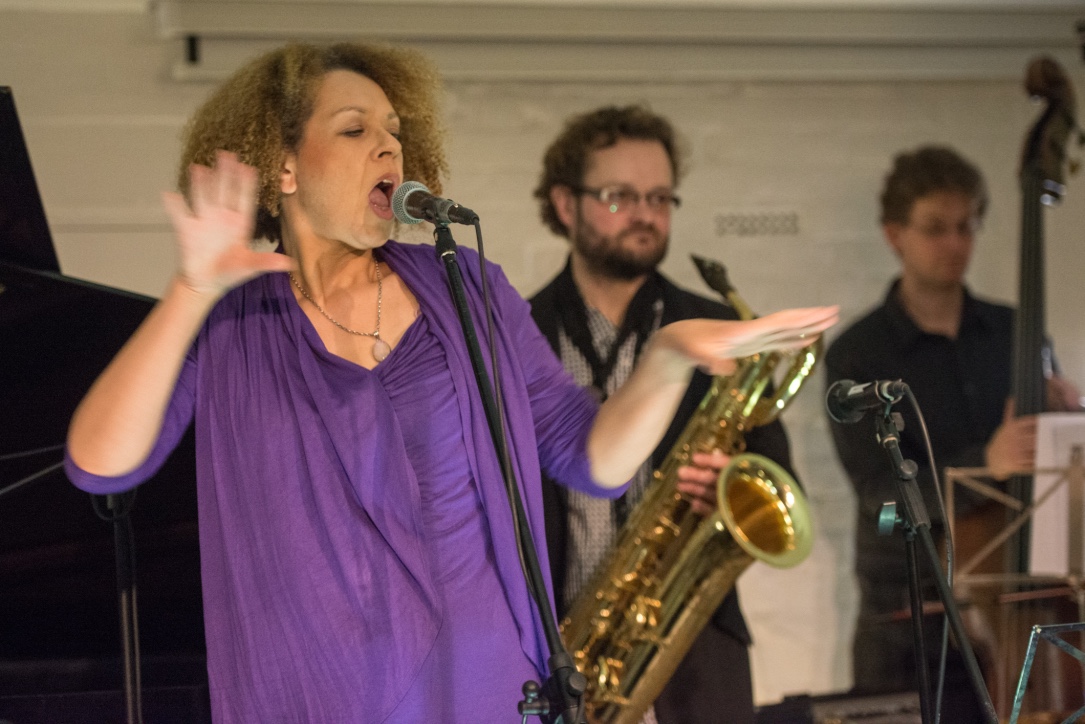
Many thanks to Tony Nandi for the wonderful photo of a performance at The Hill Station during the Telegraph Hill Festival Jazz Night
Updated version of an older post you might have read before…