Feldenkrais For Life! Reversing The Ageing Process
Summer School 2026
August 10th – 21st
10x 90 minute weekday classes
Online–Recordings & Notes included—or sign up for the recordings if you cannot join us live…
Times: 2–3.30pm BST ~ 9–10.30am EDT ~ 6–7.30am PDT – please note we start 1 hour earlier on Wednesday!
£200 (suggested fee, or any donation welcome)
You are never too old to start turning back the clock—here’s a link to Ellen Langer talking about the success of her experiment with taking elders back in time to help them regain some of their youth— and never too young to start maintaining your youthful capabilities.
My Summer Schools allow me to dive deep into the fundamentals of Feldenkrais, and demonstrate how much improvement you can achieve with a daily Awareness Through Movement practice.
Those of us who have been through a practitioner training have experienced many major changes to our health and wellbeing by the time we graduate, so we have confidence in the possibilities by the time we begin teaching others. Most of us soon discover that it is much harder for our student-clients to experience the same level of improvement that we know is possible from personal experience. Feldenkrais is about innovation and creativity, not the perfecting of prescribed actions, so we don’t work with a fixed set of ‘exercises’—in fact, in keeping with Moshe’s preferences I avoid that word when talking about the lessons I teach and the ‘homework’ I give people. I came to Feldenkrais via Tai Chi, and what made that practice so effective for me was going through the long form most mornings. The Tai Chi form is designed to develop awareness and clarity via slow movement in a similar way to Feldenkrais classes, except that Moshe was very strongly focussed on undoing established habitual behaviour. We all have some automated ways of thinking and acting, and their habitual nature makes them both hard to recognise, and hard to change. This is the main reason that we have hundreds of lessons to choose from, as this makes it less likely that our students will switch into ‘robot-mode’ while doing the lesson, however it also makes it harder for our students to know what to practice at home. I have been steadily working towards developing a ‘form of no form’ so that my students have the most effective strategies to get the maximum benefit from Feldenkrais in a committed and manageable way at their fingertips.
I started learning how to ‘Feldenkrais’ in my late 20s. When I turned 60 I really thought that would be the moment when people began to ask me how I still seemed so youthful, but the idea that declining with age is inevitable—and that it inevitably involves ever more medical intervention—is so deeply embedded into our culture that very few people question it.
The Feldenkrais Method is all about maintaining and regaining your youthful flexibility—both physical and mental—and the younger you are when you begin practising the process the easier it is to maintain the health and wellbeing you currently experience.
Moshe Feldenkrais overcame the problems he had with his damaged knee and kept up his judo practice into old age—however, even more relevant to my theme here is that he started learning piano at 75, and singing at 78. He literally never stopped learning new skills throughout his own life.
I have written a lot about this subject; here is an article on one of my favourite themes—Learning To Heal Ourselves—in it I look at all the aspects of human health, so the article isn’t just about movement, in the same way that Feldenkrais isn’t ‘just’ about movement. I firmly believe life-long-learning is the key to life-long health, and that this makes Feldenkrais the ideal path for achieving a healthy old age.
Our current culture constantly pushes the idea of our inevitable decline as we age. That we go along with this idea is partly due to how little we understand about what sort of creature we are. We are the cleverest ape because we keep on learning through life in many different ways, but principally through our capacity for language and thus one reason we are so unusually long-lived is because the wisdom of our elders is so important for our culture and community.
Maintaining vital movement abilities is just one aspect of living not just a long life but a healthy and joy-filled one too, we also need to:
Use our strength naturally in our daily life, not just in the gym
Be careful not to slip into too many rigid routines
Stay open to new ideas, challenges, and possibilities
Know how to regain lost abilities and to recognise whatever we might be doing that is causing the sort of deterioration that leads to chronic restriction and pain.
In Israel Moshe Feldenkrais is famous for teaching then-Prime Minister David Ben Gurion to stand on his head—he was 71 years old when this picture was taken:
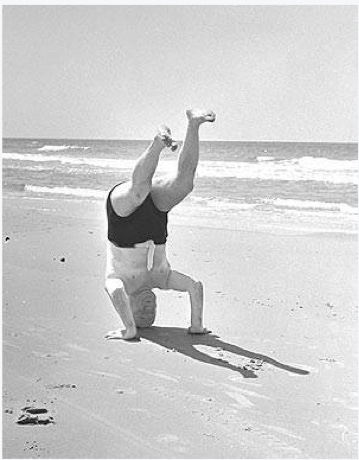
…it took him 2 years, so I am not planning to teach the head stand in this course-I will be teaching my Effortless Inversions course in the Autumn!
This 10-day course will include Awareness Through Movement lessons for:
Developing and maintaining the mobility and strength of your core
Maintaining and improving good balance
Improving all aspects of your posture
Sitting with ease and getting up from the floor [which can lengthen life]
Preserving vision and hearing
Feldenkrais-based self-healing touch techniques
Breathing for better self-regulation and respiratory health
More about the themes of this course…
What can we safely consider to be the signs of ageing? There are elements that may seem to be compulsory—greying hair and sagging skin come to mind (although recent headlines in Scientific American claim reversing grey hair may become possible—research link here).
However a great many of the ideas about ageing are worth contesting, and there is ever growing evidence of what is possible if we are prepared to improve our diet and change our behaviour. Here are some of the possible improvements we can make for ourselves…
Maintaining and improving bone strength
Managing our hormonal changes more effectively
Maintaining our vitality, including our libido
Maintaining and improving both our general mobility, and specific abilities
Slowing the decline, preserving, and possibly improving our sight and hearing
Maintaining and improving our balance
This course will include plenty of time for discussion in the final third of the class. We need to keep in mind the way issues with our health often develop slowly over time—eat the wrong thing occasionally and we are unlikely to have an issue, however eat it everyday and it’s like regularly applying a little dose of herbicide to the garden, eventually we will be able to clearly see the damage we have been doing. Symptoms are the messages we get from our network of health systems to signal that something is not right, and our medical system’s response to that is to suppress the symptom while doing nothing the deal with the deeper cause.
Instead our culture treats this slow decline in our health as if it were something we have ‘caught’, like a virus, or something unavoidable and inevitable—”age-related”—by vastly over-emphasising the effects of our genes [nature] and underestimating the effects of our environment and behaviour [nurture]. Thus, instead of looking for ways to pause and reverse the damage being done in order to return us to an earlier state of better health, instead the doctor gives us medications to better disguise the ongoing damage by suppressing our symptoms—the vital alarm signals from within evolved over millennia to enable us to work out what is wrong in order to heal ourselves. To add insult to injury when those medications—which are unavoidably interfering with our immune system’s natural functioning—begin to generate symptoms of their own [euphemistically known as ‘side effects’] they then give you medications to manage the newly generated issues, and of course these new pharmaceuticals all come with new side effects of their own. I have no idea how this chaotic approach became a working model of maintaining health, but I do know that the statistics for illness and death directly related to medical ‘care’ are steadily rising [Iatrogenesis—see below], and that older people in care homes can often be on between 7-10 medications a day.
Iatrogenesis, or the adverse effects and risks associated with medical interventions, poses a significant challenge in global public health as it ranks as the fifth leading cause of death worldwide and a leading cause of death in numerous countries. Prior to the coronavirus disease 2019 (COVID-19) pandemic, 2.6 million deaths occurred annually due to safety lapses in hospitals in low-income countries, while nearly 15% of hospital expenditure and activity in developed nations were attributed to addressing treatment safety failures.
Full article here: Iatrogenic Disease in General Practice: Its Incidence and Effects
Here are some questions to ask yourself…
What have you stopped doing that you used to love doing?
What did you want to do when you were a kid? What do you still wish you had more time for?
What have you stopped doing that you used to do with ease without thinking; sitting on the floor, sitting cross-legged, kneeling, moving around on your hands and knees? For example, how easily do you get down on the floor in order to retrieve dropped items that have rolled under furniture, or reach upwards to change a light bulb?
How easily do you sit on a chair for work; how easily do you get up out of the chair again?
Do you ever…
Jump?
Sprint for a bus?
Dance around the house and/or sing along to your favourites when they come on the air?
Sing or laugh out loud when you are on your own
Hug people you have only just met
Thank people who provide you with a service—bus drivers; delivery people; pub and shop staff?
Greet your neighbours
Hold doors open for the people behind you
My master plan for this course is the idea is that you can design a manageable youthfulness practice, that is tailor-made to your specific needs—something to work towards steadily, and patiently, one step at a time.
It needs to include:
Physical activities—preferably out in the world not just what you can easily do at home—fortunately walking is ideal, and easy to do regularly, with or without company. No need to count your steps, but do climb hills, and walk on uneven surfaces in thin soles.
Mental stimulation and development—what have you always wanted to do that you are still putting off—how long are you prepared to wait for the right moment to come along? Moshe Feldenkrais began singing at 78, and deeply regretted not starting sooner.
Emotional connection and satisfaction—this is very important for long term health and well-being, and there are very few certainties we can call on in the process of finding nourishing relationships. Many of us rely on our pets as we get older and begin to lose our friends. Finding ways to connect joyfully with others might be our biggest creative challenge.
—and if you are of a mind then spiritual development is important too—this often overlaps with our emotional wellbeing; there is no easier way to connect to your local community than to join a local spiritual group. This doesn’t need to be a church, there are meditation classes, and spiritually focussed dance communities out there too. This aspect of our health can overlap with the other two elements as well. Qi Gong is both physical and spiritual; vigorous physical activity often improves our mood and boosts our sense of wellbeing; joining a choir or volunteering in a local charity can be a good way to feed the spirit and the heart.
There is no end to the possibilities we can explore in this area—I look forward to the discussions we will have as much as the individual practices we will be developing together—contact me here if you would like to book onto the course.